Three catalysts from our lab — fertiliser from air, recycling carbon, and clean hydrogen
Chen-Cheng Liao (廖振成) Department of Chemistry, Fu Jen Catholic University, New Taipei City, Taiwan Computational chemistry & AI · 165804@mail.fju.edu.tw
Why catalysts? Food, fuel and clean air
A catalyst speeds up a reaction and steers it to one product — without being used up
1
Enzymes
Nature's catalysts. Digestion and fermentation run on a few special spots on each enzyme — its active sites.
→
2
Fertiliser
An iron catalyst turns nitrogen from the air into ammonia — the fertiliser behind roughly half of the world's food.
→
3
My lab
Small metal particles and surfaces for fertiliser, carbon recycling and clean hydrogen, driven by electricity.
Key messageFrom enzymes to metal surfaces, the chemistry is decided at active sites.
One question — “who are your neighbours?” — three catalysts
An atom behaves according to the atoms around it. Our three catalysts add more and more kinds of neighbours
A copper heart in a ruthenium shell
one special site, engineered · fertiliser · 2024
→
Iron–copper clusters
change the recipe · carbon recycling · 2025
→
A five-metal alloy
thousands of different sites · clean hydrogen · now
Key messageChange the neighbours, change the chemistry — and more kinds of neighbours make it harder.
Story 1 · Fertiliser from air: a copper heart inside a ruthenium shell
Can we make urea — the most common fertiliser — directly from CO₂ and N₂, using electricity?
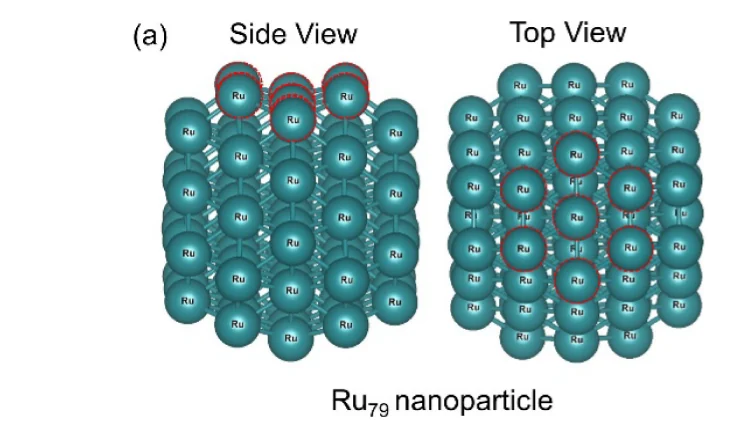
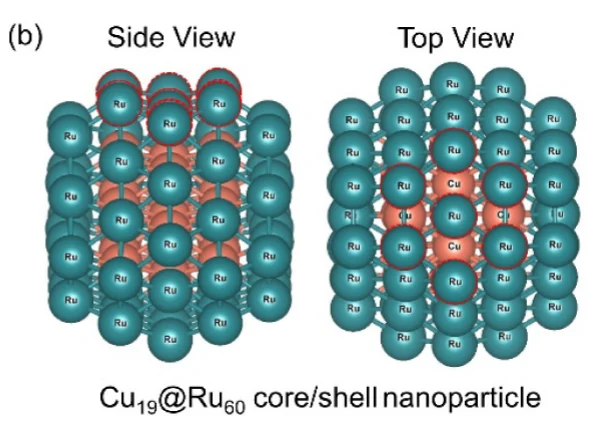
(a) A ruthenium particle (79 atoms). (b) The same shell with 19 copper atoms hidden inside. Liao, Huang & Chang, J. Phys. Chem. C2024, 128, 12093.
The copper atoms are buried — they never touch the gas. Yet they retune the ruthenium surface above them (its d-band centre moves from −2.56 to −2.23 eV).
N≡N is one of the strongest bonds in chemistry. In the small “valleys” of this shell it splits with a barrier of only 0.28 eV.
Then carbon and nitrogen can join — C–N coupling — on the road to urea.
Key messageHidden atoms can tune the surface: one carefully engineered site.
Story 2 · Recycling carbon: change the recipe, change the road
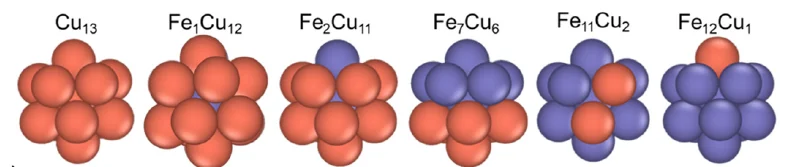
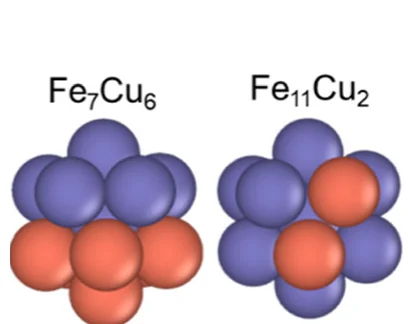
Thirteen-atom iron–copper clusters, from all copper to almost all iron, turning CO into two-carbon products
Same size, six recipes — copper (orange) is replaced step by step by iron (purple).
Two recipes, Fe₇Cu₆ and Fe₁₁Cu₂, hold the key intermediate just right — and open the road to C–C bonds and products such as ethanol.
Wrapping a cluster inside a carbon nanotube keeps it stable and shifts the energies further.
Key messageThe recipe — not only the elements — decides which road the reaction takes.
How we read the route: one free energy per step
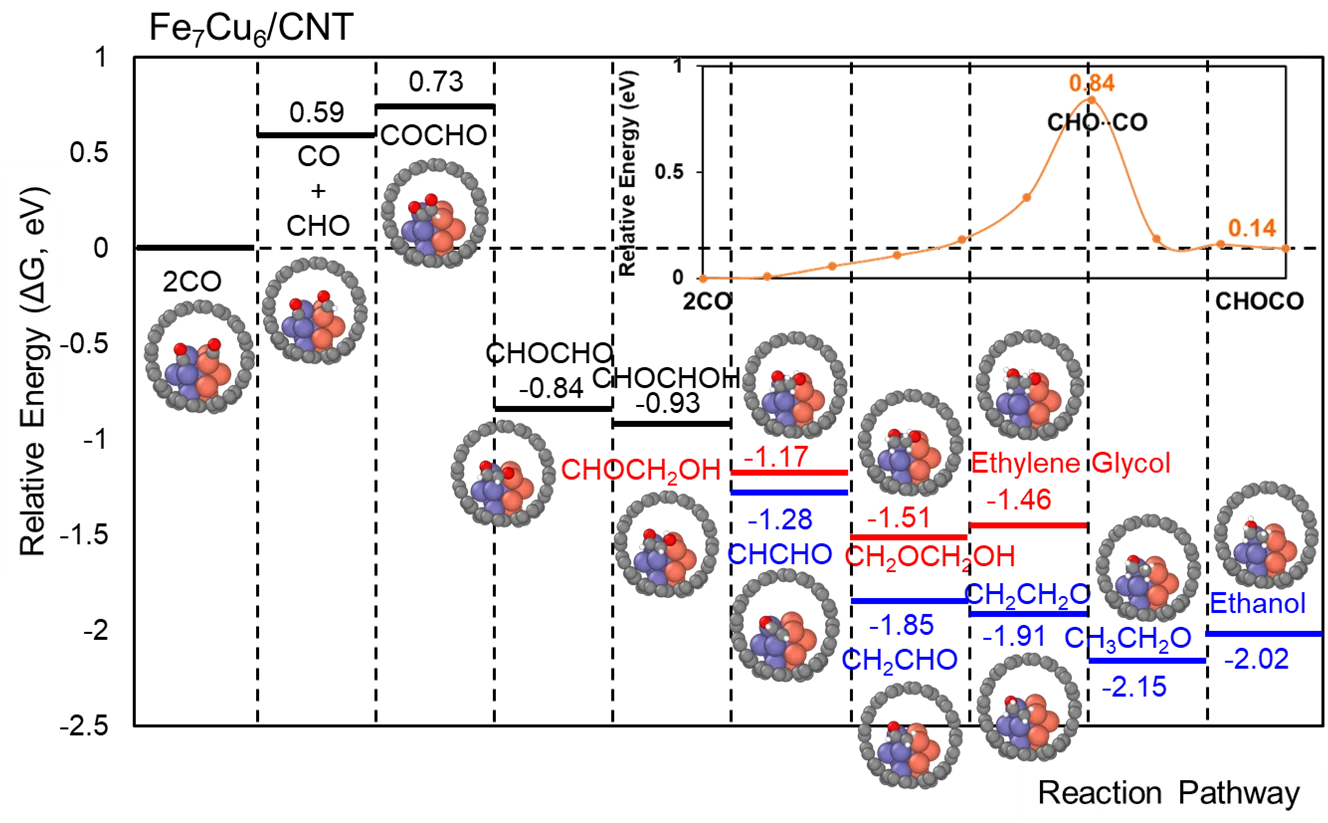
Every level is one intermediate on the cluster; we compute them all, then follow the downhill road
CO reduction on Fe₇Cu₆ inside a carbon nanotube; colours mark competing roads. Phys. Chem. Chem. Phys. 2025, Fig. 5.
Each level is one computed intermediate. Downhill steps are easy; uphill steps cost energy.
The favourable road passes two key intermediates and keeps going downhill to two-carbon products such as ethanol.
The small inset is the moment the C–C bond forms — the step that makes recycling carbon worthwhile.
Key messageWe do not guess the route — we compute every step and read it off the map.
Story 3 · Clean hydrogen: a platinum skin over a mixed-metal core
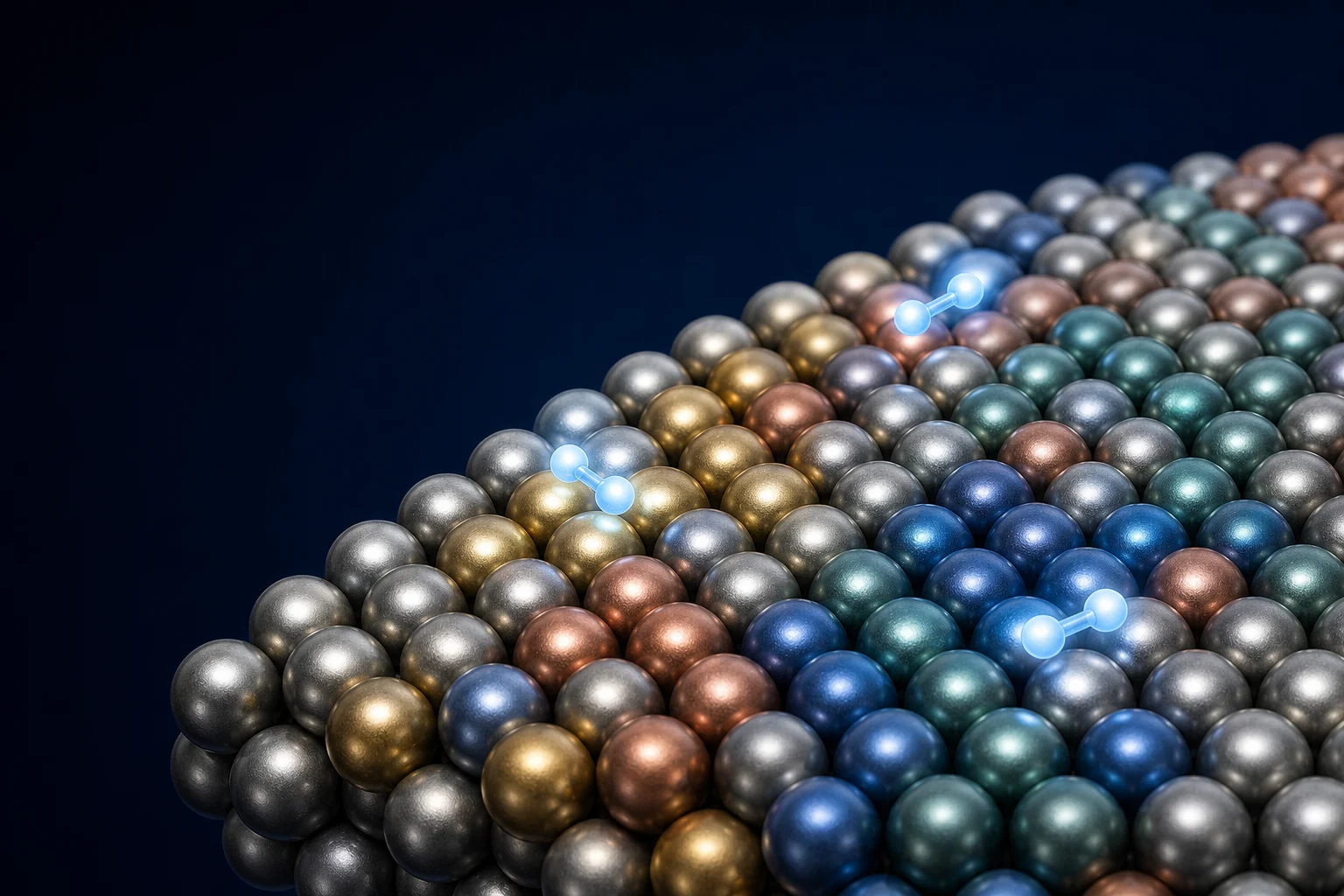
Platinum is the benchmark for hydrogen evolution but scarce: keep one layer of it on top, and mix five metals at random underneath
The Pt skin preserves Pt-like surface chemistry, while the buried high-entropy environment is used to tune H adsorption.
Key messageKeep a Pt-like surface, let buried atoms tune it, and use less Pt.
07
Same platinum surface, 96 different answers
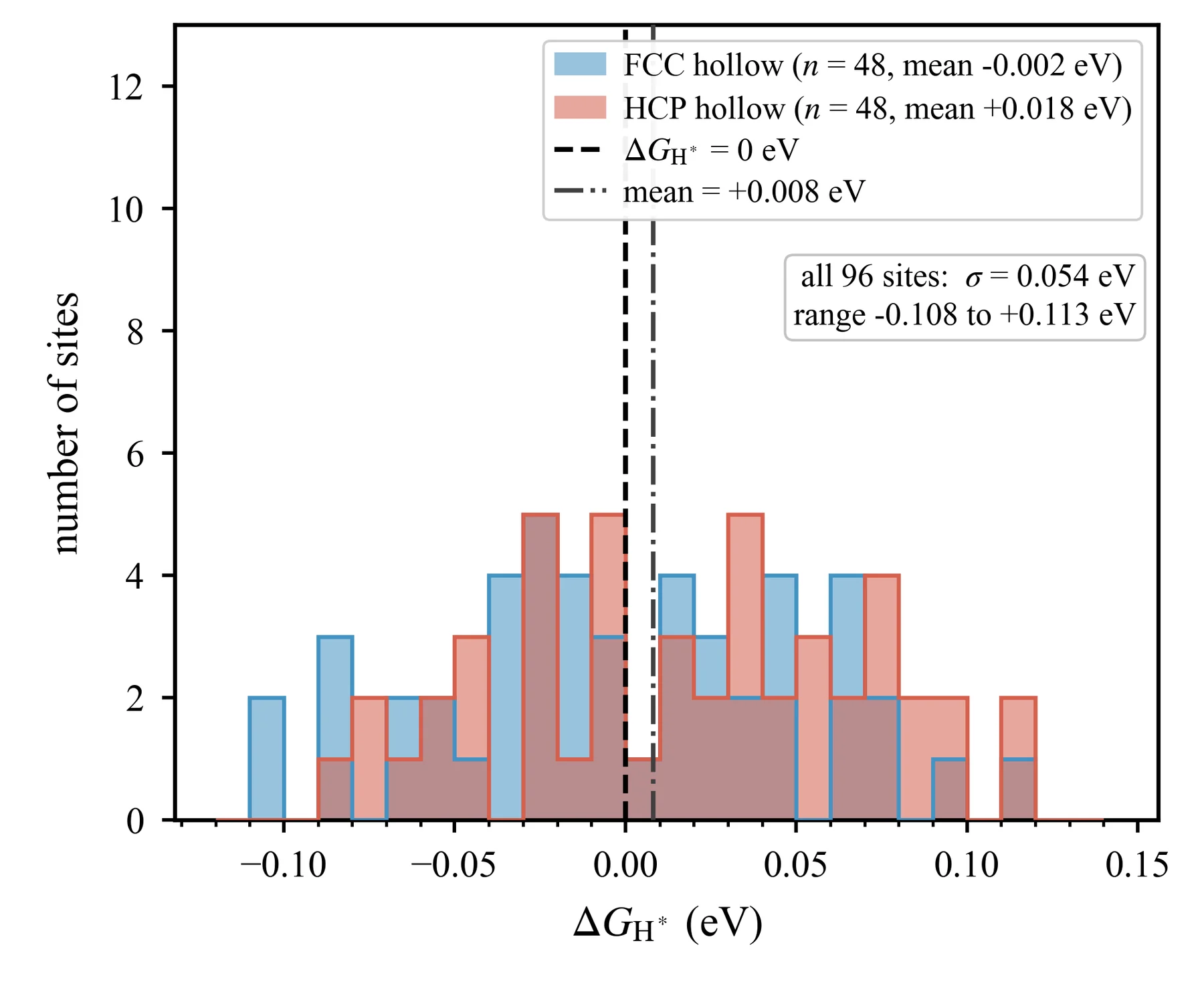
We computed how tightly hydrogen is held at every one of 96 spots on three model surfaces
Each bar counts sites with a given hydrogen-binding energy (left = tighter grip). Blue and red are the two kinds of hollow site.
96
sites — every one of them made of three platinum atoms
≈ 0.2 eV
spread from the strongest to the weakest grip — large enough to matter for a catalyst
If the surface were pure platinum, all 96 bars would sit on one line.
Key messageThe atoms you cannot see change what happens on top.
07 / 18
What lies underneath decides
Look through the platinum skin at the atoms just below each site
how tightly H is held
Holds hydrogen tighter.
how tightly H is held
Lets hydrogen go more easily.
Nickel, cobalt and copper sit in between — too close to rank with only three model surfaces. Schematic; same trend in all three slabs we computed.
Key messageChoose what you bury, and you tune what happens on top — a design rule instead of trial and error.
Three catalysts, one lesson: from one site to a population
As the recipe gets more complex, “the best site” is no longer enough
Copper heart in ruthenium
engineer one special site
→
Iron–copper clusters
tune the recipe
→
Five-metal alloy
design the whole population of sites
Next: real surfaces change while they work, so we need to sample many more structures — this is where machine-learned force fields come in.
Key messageThe more complex the material, the more we need statistics — not just one “best site”.
More questions, with experimental partners
Most of these began when a lab came to us with something it could not yet explain
Clean hydrogen
Platinum on nickel frameworks
Where does hydrogen stick, and why does it leave easily?
Electrochemistry
Tungsten-doped nickel hydroxide
What does the catalyst turn into while it is working?
Clean water
Sponges for “forever chemicals”
Porous frameworks that pull PFAS out of water.
Light
Copper–sulfur clusters that glow
Where in the cluster does the light come from?
Light
Chiral 2-D perovskites
Why do left- and right-handed crystals treat light differently?
Batteries
Layered MXene electrodes
Why do the layers swell when molecules slide in?
Life
Gene-editing Cas9 proteins
A molecular movie of how a protein holds DNA.
Next?
Your question
We are always looking for new partners — and new puzzles.
Key messageDifferent materials, same method: ask the atoms who their neighbours are.
From the laboratory to the classroom — the same rule
What I have just shown you and what I will show you next were built the same way
In the research
The chemistry is the core; machine learning is only a check on what the physics already says.
Every number on a slide is re-checked by a script before it is shown.
We work with experimental partners — the computer explains, it does not replace.
In my teaching
The teaching judgment is the core; AI only builds the tool — and it is not on the student's screen.
Every question and every page is reviewed by me before it goes live; the tools carry automatic tests.
The unit of work moved from one slide deck to one lesson file that expands into many outputs.
AI replaces the cost of building — not the judgment of what to build.
Key messageOne rule for both halves of this talk: keep the judgment, outsource the construction.
Part 2 · Teaching
AI in My Chemistry Classroom: What I Built, and What Stayed Mine
A personal account for fellow teachers — five classroom problems, the tools that came out of them, and the rules I now follow
22public web tools, one year
5classroom problems first
0AI answering on the student's screen
Chen-Cheng Liao (廖振成) · Department of Chemistry, Fu Jen Catholic University I teach physical chemistry, organic chemistry and computational chemistry to undergraduates
I started from classroom problems, not from tools
Each of these had bothered me for years; none was invented to justify a tool
What actually happens in class
What I built
Status, Oct 2026
Students are lost — but nobody raises a hand
ClassPulse · live comprehension check
in use since 17 Sep 2026
Stereochemistry drawn flat on a whiteboard
Organic 3-D Explorer · 21 molecules
in use, organic chemistry
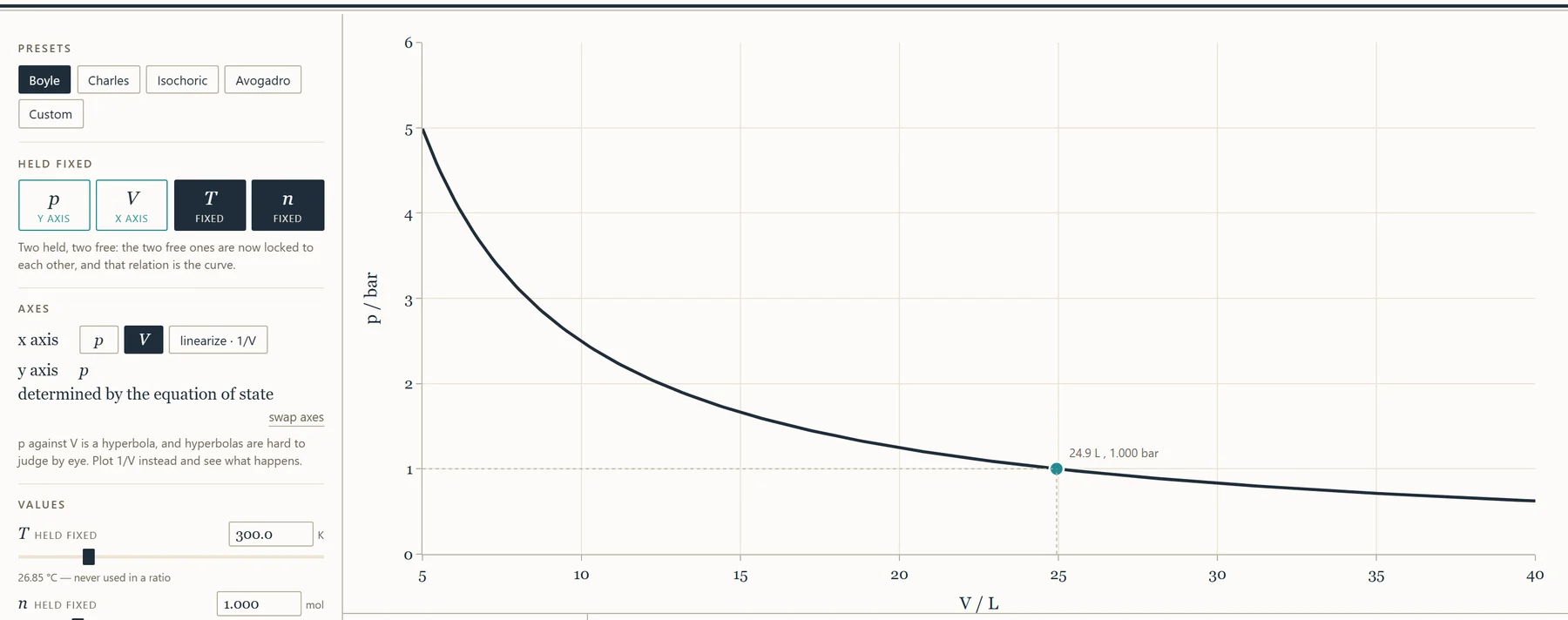
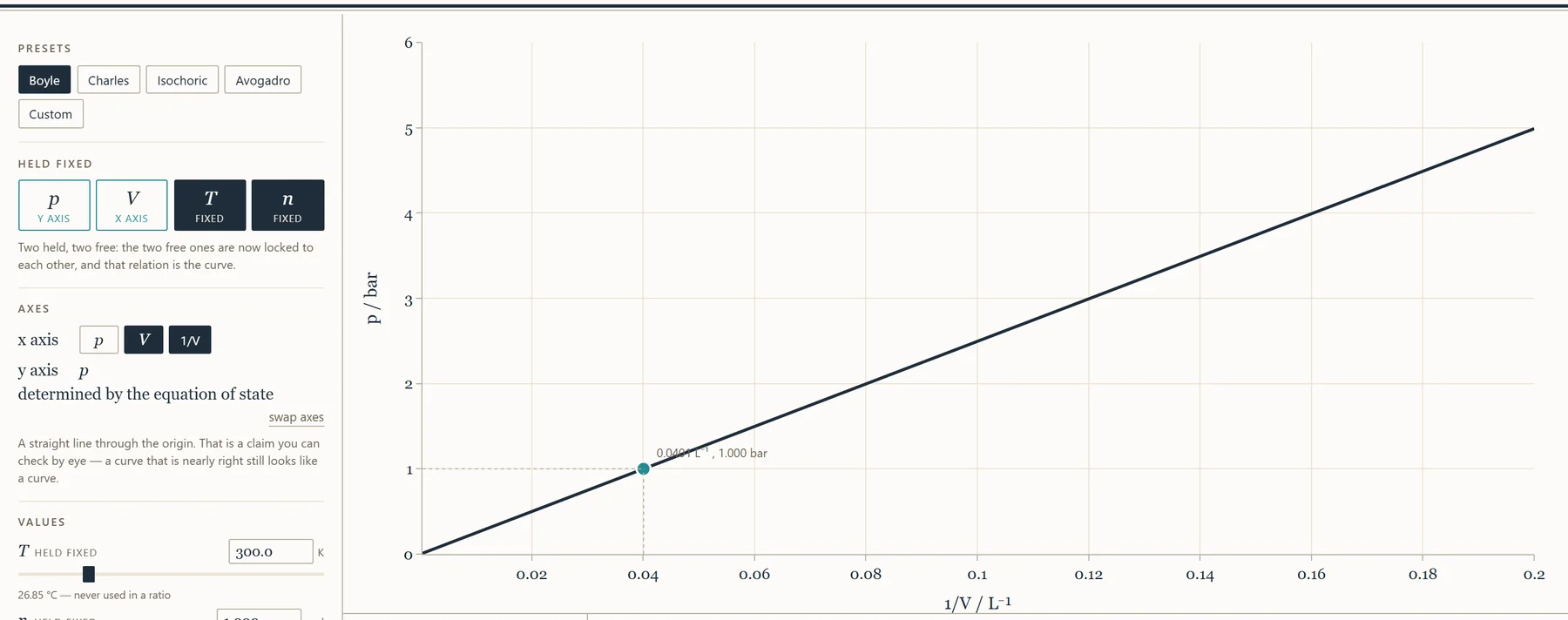
pV = nRT is memorized; four coupled variables are never felt
EOS Explorer · interactive equation of state
in use, 1st-year physical chemistry
No reason to learn chemistry vocabulary in English
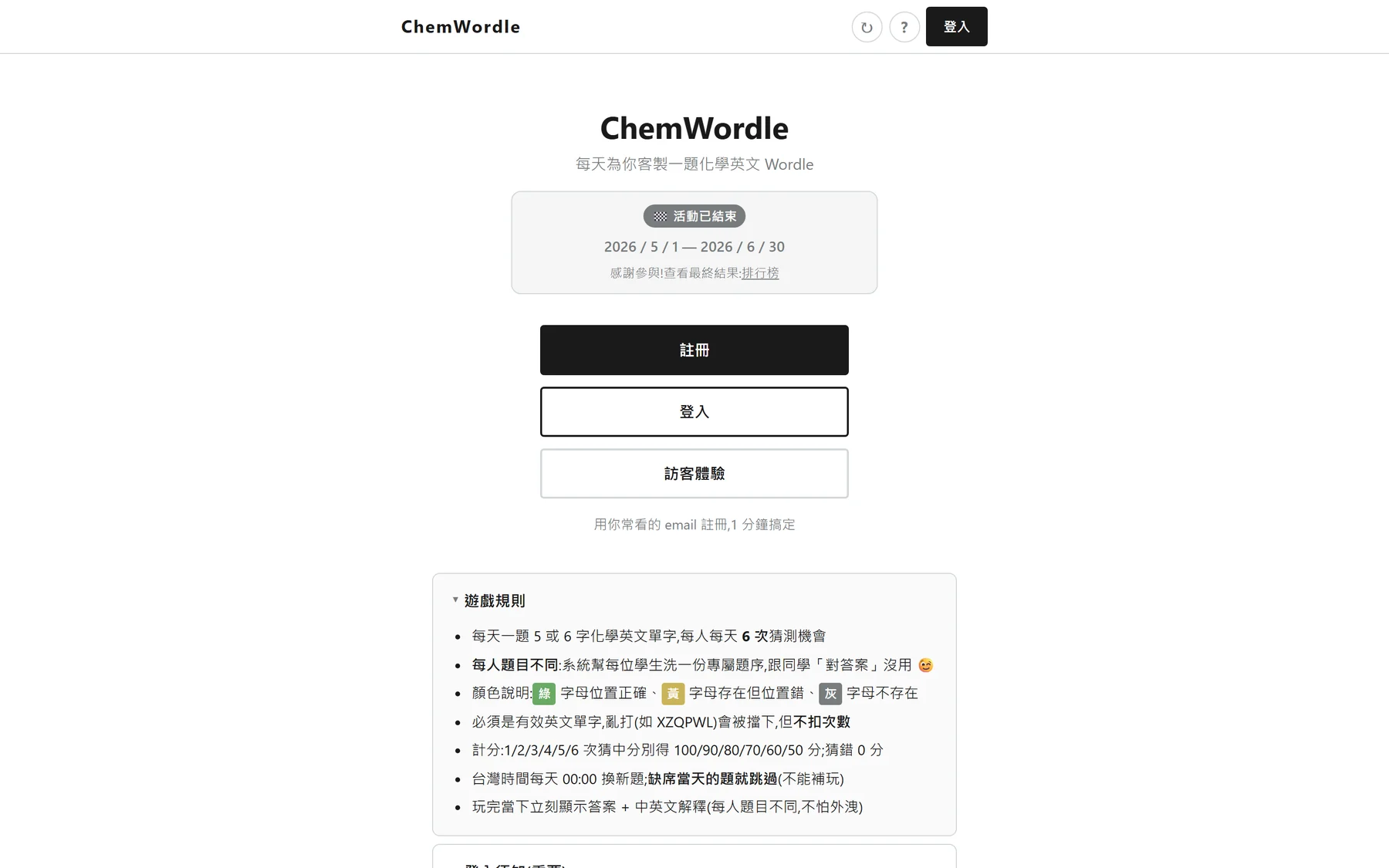
ChemWordle · one word a day
ran May–June 2026
Students never read a primary research paper
30-Day Paper Challenge
platform ready · 33 papers, 99 questions
When students use any of these, no AI is answering them. AI appears in one place only — turning the idea into a working tool — a step that used to be outsourced or never happened, and now takes a few days.
Key messageStart with the problem you already have. The tool is the cheap part now.
The line I drew first: AI builds the tool — AI does not teach my students
Not everyone in the room needs to be optimistic about AI for this to work
1
Where AI works
Turning a one-paragraph idea into a working web page — in days, not months. Code, layout, tests, deployment.
→
2
Where AI is absent
The student's screen. No chatbot answers, no generated feedback, no AI-written hints during class.
→
3
What stays mine
What to teach, what to test, how to grade. Every question and every page is reviewed by me before it goes live.
Key messageIf you worry that AI will give students wrong answers — in these tools it never gets the chance.
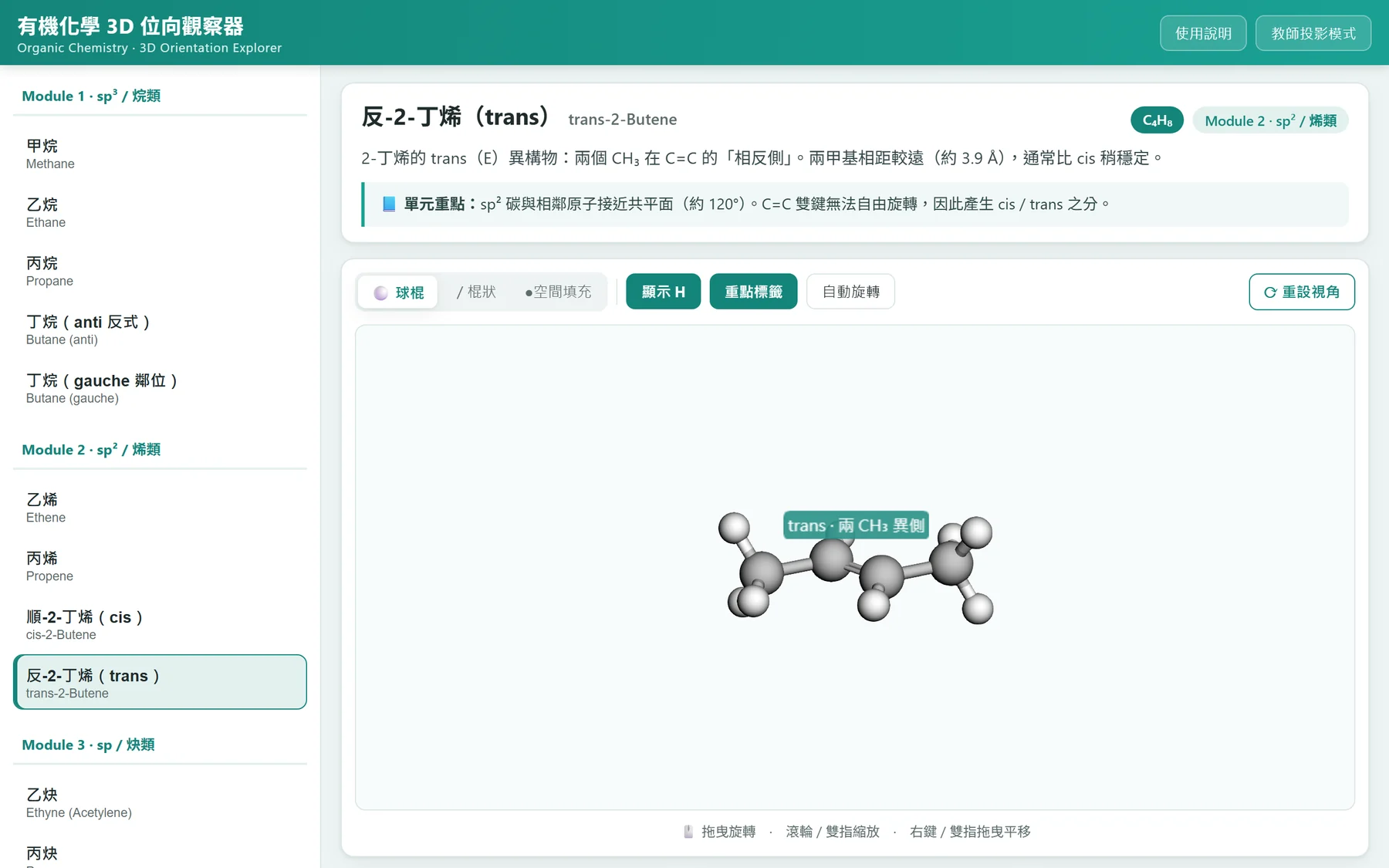
Organic chemistry: seeing stereochemistry in three dimensions
A whiteboard cannot show a dihedral angle; a phone can — Organic 3-D Explorer
Rotate, zoom, switch ball-and-stick / stick / space-filling, toggle hydrogens, and show the teaching label (here: trans — the two CH3 groups on opposite sides).
21 molecules in five modules: sp³ alkanes, sp² alkenes, sp alkynes, cycloalkanes, aromatic rings.
Built as pairs: butane anti vs gauche · 2-butene cis vs trans · methylcyclohexane axial vs equatorial · xylene ortho / meta / para.
Geometries from RDKit, rendered with 3Dmol.js. No login, no server, runs from one folder offline. A projector mode for the teacher.
One chemistry word a day in English. Every student gets a different word order, so comparing answers is useless — a design, not a rule. Wrong guesses outside the dictionary do not cost a try.
Press “summon”: an animation draws a student with a rarity level. Purely for fun — but attendance stops being a threat. Before AI, nobody would build this; the return was too small. Now it is one afternoon.
Key messageLow-cost tools make small, humane ideas worth building.
ClassPulse: for the students who are lost but will not raise a hand
Live since 17 September 2026 — you can try it right now from your phone
1
I type one sentence and press Publish
from my phone, mid-lecture: “the part I just explained — clear?”
2
Students open one fixed address
three big buttons: following · a bit stuck · explain again
3
I see the distribution in seconds
plus an anonymous question box for those who never speak
No login, no names, no student numbers. One vote per student is enforced by database rules, not by trust. Adding a classroom is one line of configuration. There is no question bank — you cannot know in advance which sentence loses the class.
Key messageDuring the lecture there is no AI anywhere in this loop — just a faster way to hear the quiet half of the room.
Reading real papers: separate the AI-allowed stage from the assessment stage
30-Day Scientific Reading Challenge — my answer to “will students just cheat with AI?”
One abstract unlocked per day, three questions each: what did they ask, what did they do, why does it matter. 30 real Nature Communications papers, CC BY 4.0, credited and linked. ▶ nc-reading-challenge.pages.dev (guest mode, no login)
Reading stage: translation and AI are explicitly allowed — they are comprehension tools.
Answering stage: the server releases one question at a time, timed, options shuffled, no edits after submission, a different order for every student.
What is tested is did you understand it — not did you use a tool.
Honest status Platform complete, 33 papers and 99 questions loaded; the questions were drafted with AI from the abstracts and I am still reviewing every one before launch.
Key messageDo not ban the tool; split the process so the tool cannot do the part you are grading.
AI prompting ① — the students write the prompts, not me
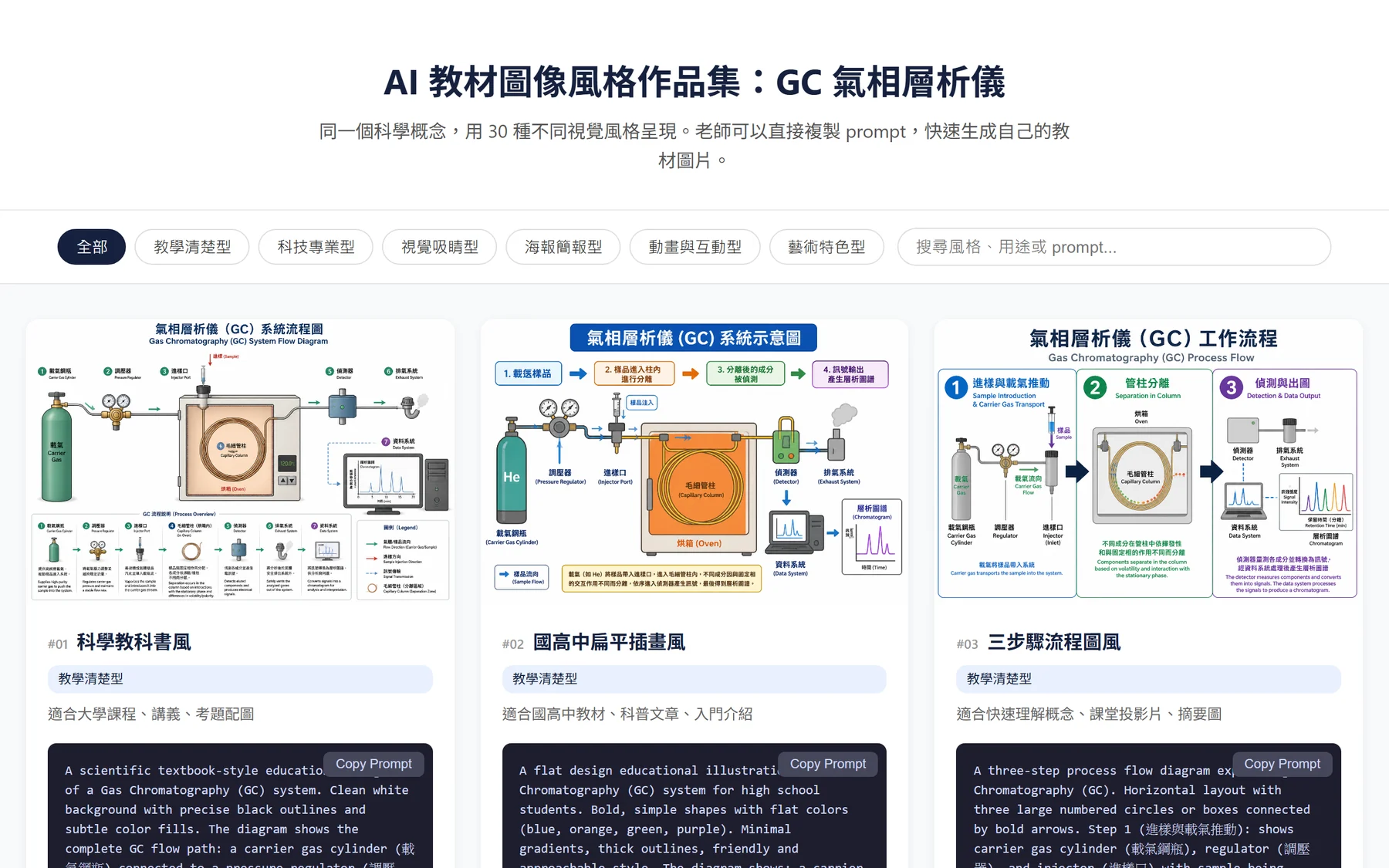
The AI Prompt Gallery: one theme a week, every student submits a prompt, the pictures come back as a class exhibition
Six of this semester's 116 student-prompted images (names removed). Same theme, very different prompts.
How it runs: I open a round with a theme and a deadline → students submit a prompt from their phone → I generate all images in one batch on my own computer (the key never leaves it) → the wall opens and the class votes.
What they learn: a vague prompt gives a vague picture, and the second attempt is usually better than the first.
Key messageA prompt library lets a colleague start from a working prompt instead of a blank box.
AI prompting ③ — how I prompt an AI to build a tool
A prompt is a specification, not a wish — and the specification is where my judgment lives
1
One classroom problem, one sentence
“students who are lost do not raise a hand”
2
A written work order
what it must do · what it must never do · how we will know it works
3
The AI implements
an agent writes code, runs it, fixes its own errors
4
Machine checks
tests that fail loudly if the physics or the rules break
5
I review, then publish
free static hosting; a link or a QR code is all students need
The work order for ClassPulse (excerpt)
• Students never log in; no names, no IDs.
• One vote per device per question — enforced by database rules, not by the page.
• Teacher page must work from a phone with one hand.
• Adding a classroom = changing one line.
• If the network drops, the student page must say so, not silently fail.
Nothing in that list is about code. It is about my classroom. The AI supplied the construction; the specification supplied the judgment.
Key messageThe better you can describe your classroom, the better the tool — no programming background required.
“Will AI make students think less?” — three design answers
The question I am asked most. My answer is in how the tools are built, not in a policy
1
Predict first
EOS Explorer hides the curve and the formula until the student commits to a prediction. Nothing is shown that could be copied before thinking.
2
Separate the stages
The paper challenge allows AI while reading and removes it while answering. The grade measures understanding, not tool use.
3
Make recall faster than lookup
UnitSense: six cards, the same pressure in six units, order them against the clock. Conversion tables are allowed — they just cost time. Knowing 1 atm ≈ 101 kPa ≈ 760 torr is always faster. ▶ unitsense.ccllab-tw.com
Key messageDecide which cognitive act you want to keep, then build the tool around protecting it.
Behind the classroom: one lesson file, many outputs
28 thermodynamics lessons, each a single structured file → slides, concept map, teaching animation — change once, all three update
Constant volume · the container cannot move → pressure rises
Constant pressure · the container can move → volume rises
Container position, gauge, thermometer and axes are identical in both animations; one boolean differs. The videos are not edited — they are computed from one scene program, with no stock images, fonts or music, so they can be versioned and compared like code.
Key messageThis precision is what AI changed for me: a teaching animation became something a teacher can regenerate, not something to commission.
Worth sharing: fab24hr — a day in the life of a chip-fab engineer
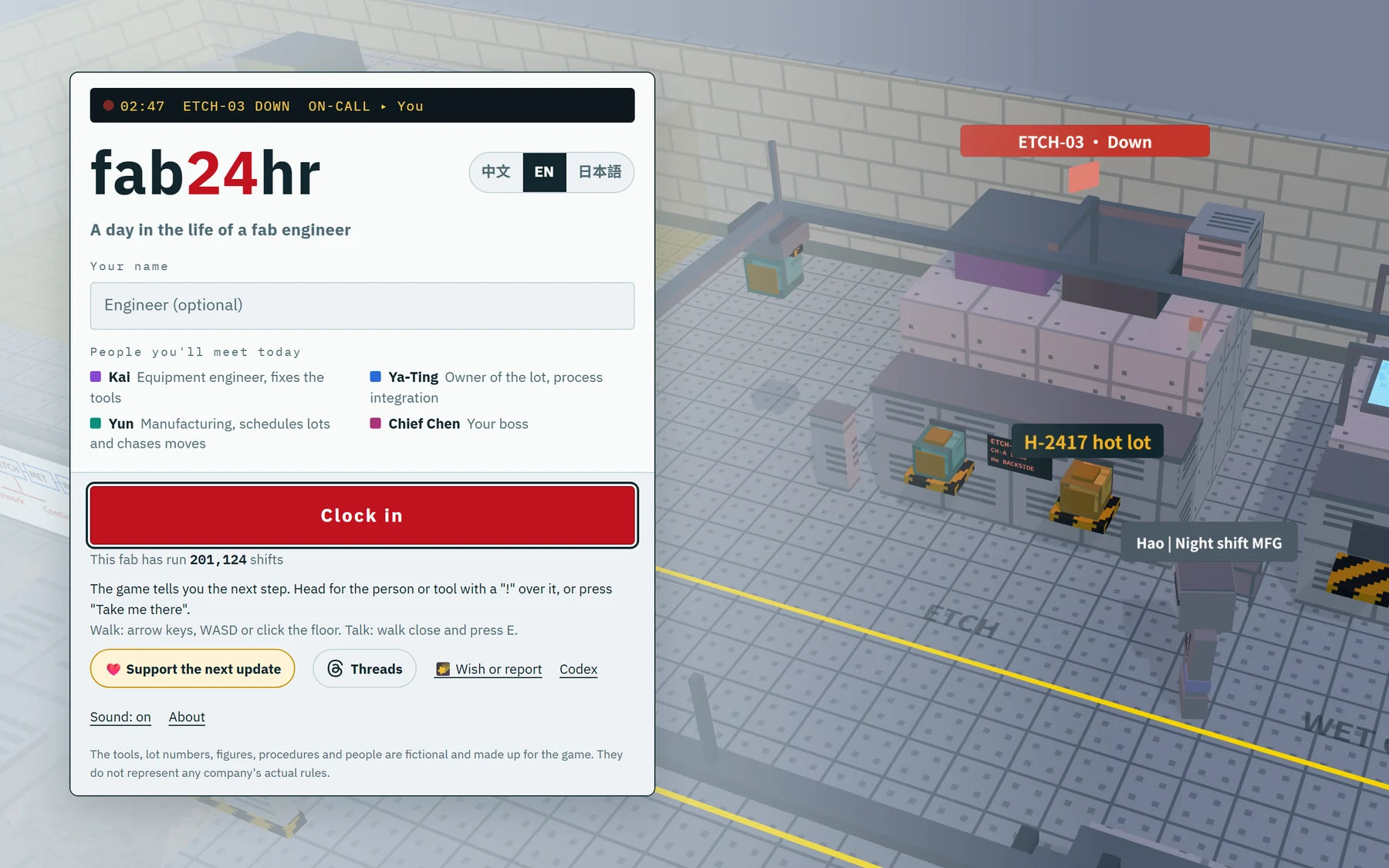
A free 3-D web game I did not make: you clock in at a semiconductor fab where an etch tool broke down at 2:47 a.m.
The English start screen. Walk with the arrow keys, talk with E; the game tells you where to go next.
Walk through a 3-D fab and talk to the equipment engineer, the process-integration owner, manufacturing and your boss — then decide when the lots can move again.
Four roles, an R&D line and a production fab; in English, Chinese and Japanese.
Students meet the people and jobs behind a chip, not only the chemistry. The tools, numbers and procedures are fictional — the site says so.
Key messageYou do not have to build every tool yourself — good tools made by others are worth passing on.
If you want to start tomorrow
Four rules I give colleagues who are not engineers — and that I follow myself
1
Pick a task you already have to do
If AI saves you 30 minutes, continue. If it does not, drop it — no guilt. The goal is your week, not the technology.
2
Start from one classroom problem, not from a tool
Write the problem in one sentence first. The sentence is more valuable than any software.
3
Keep AI off the student's screen until you have a reason
Build with it, decide without it. Every tool shown today works without a single AI call during class.
4
Review everything before it goes live
Tools are cheap now; your judgment is not. Read every question, click every button, once.
Key messageThirty minutes saved on a real task is the only test that matters in the first week.
Thank you
Questions welcome — on the buried atoms, or on the classroom
Chen-Cheng Liao (廖振成) · Department of Chemistry, Fu Jen Catholic University 165804@mail.fju.edu.tw · Research supported by NSTC 114-2113-M-030-015-MY2 · all teaching tools: demo.ccllab-tw.com With students Peggy P. M. J. and Yu-Huan Huang (黃宇桓)
Backup · for Q&A
Backup — details of the platinum-skin study
For questions: methods, the subsurface pool, substitution contrasts, the d-band, machine learning, scope, and how the random-alloy models are built.
Where the calculations run
From a laptop in class to Taiwan's national supercomputers
My laptop
teaching demos, small molecules, every web tool in Part 2
National supercomputer (CPU)
most of our quantum-chemistry calculations — a 96-atom metal slab is a typical job
GPU cluster
protein movies and the largest quantum-chemistry jobs
≈ 16×
Our own benchmark: the same kind of calculation on 4 GPUs ran about sixteen times faster than on 96 CPU cores — what took two days now takes about three hours.
Key messageFaster machines change which questions we can afford to ask.
06
Methods overview
Fe–Co–Ni–Cu–Pt Pt-skin (111): from random structure to descriptors
1
SQS bulk
three 256-atom SQS models (ICET), equimolar target
2
Pt-skin slab
one 4×4×6 slab cut from each · 96 atoms · top layer all Pt · common in-plane a0
3
96 hollow sites
all FCC + HCP, 3 slabs, one H per cell
4
DFT ΔGH*
VASP, per site
5
Descriptors
subsurface pool fractions · d-band center · ML as a diagnostic
Numerical sensitivity (four sites, k-mesh / cutoff / forces): a single site moves by up to 31.8 meV, mostly common to all sites; a difference between two sites moves by at most 5.6 meV.
Key messageA controlled 96-site hollow-site dataset on three SQS-derived Pt-skin slabs — site differences are what the data resolve.
06 / 18
What we count: the subsurface pool beneath a hollow site
An x-ray view from the Pt skin into the first subsurface layer — six atoms under an FCC hollow, seven under an HCP hollow
An H atom adsorbs in a 3-fold hollow site on the Pt skin.
Make the skin transparent: the three surface Pt atoms share a pool of first-subsurface neighbours — 6 atoms at an FCC hollow, 7 at an HCP hollow (the atom directly below is shared).
Descriptorfn,X = nX / N, the pool fraction of element X → here Pt 2/6 · Fe 1/6 · Co 1/6 · Ni 1/6 · Cu 1/6. No distance cut-off, same scale for FCC and HCP.
Key messageEach site's descriptor is the element makeup of the subsurface pool under its hollow, expressed as fractions.
Replacement effects give a chemistry-readable ordering
Instead of an absolute effect per element, ask what happens when one subsurface atom is replaced by another
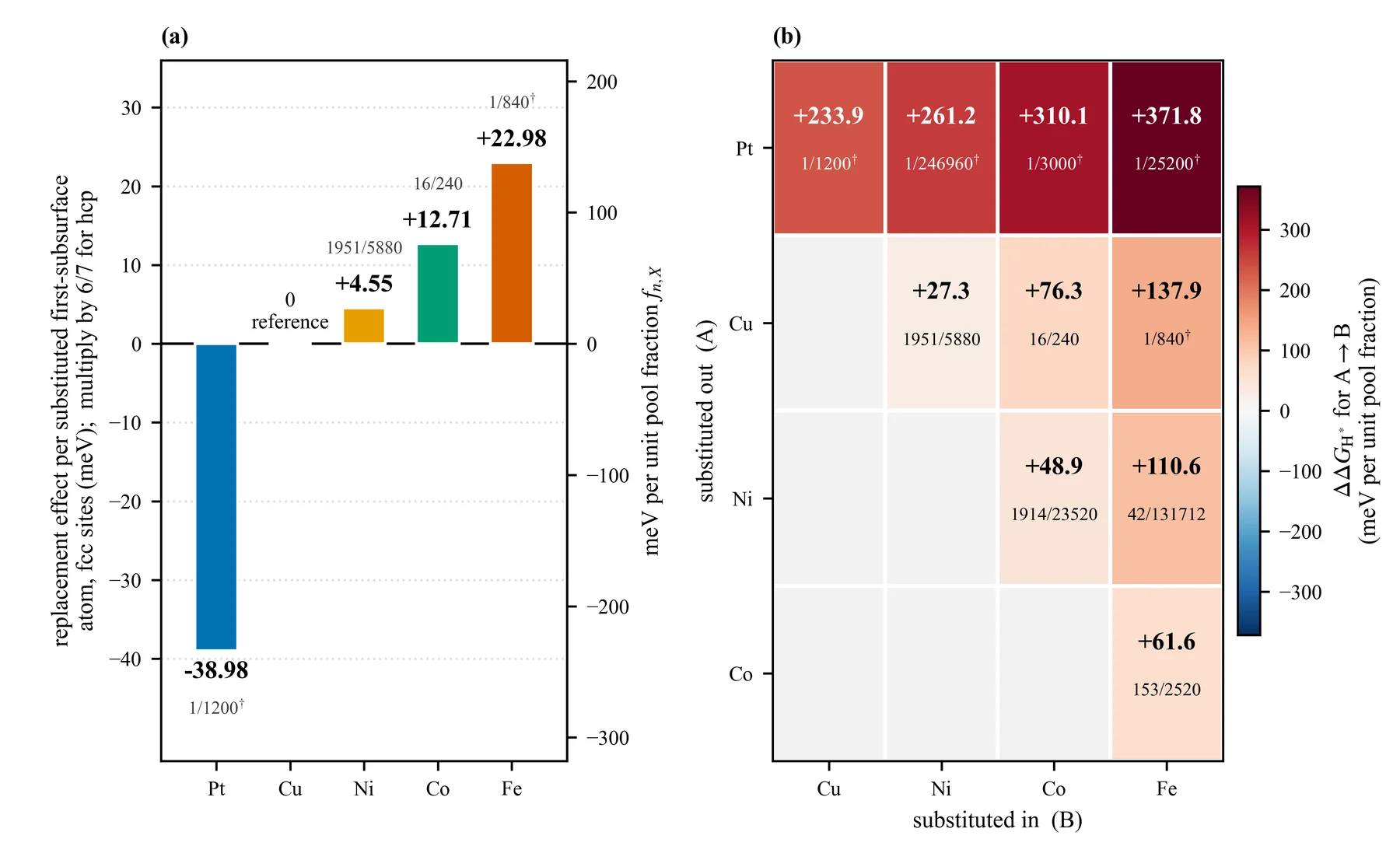
Figure 3 (manuscript). (a) Per-atom replacement effect at FCC sites relative to Cu; (b) ΔΔGH*(A→B) per unit pool fraction. Negative = stronger H binding.
Point estimates: Pt > Cu > Ni ≈ Co > Fe Pt and Fe are the clear endpoints; the middle is not resolved in three slabs
Fe → Pt: ΔΔGH* = −372 meV per unit pool fraction (≈ −62 meV per atom at an FCC site) — replacing subsurface Fe by Pt makes H binding stronger. Same sign in all three slabs (−331, −395, −289). The contrast does not depend on which element is the reference.
Per atom, relative to Cu: Pt −39.0 · Ni +4.6 · Co +12.7 · Fe +23.0 meV. The order follows Pauling electronegativity (Pt 2.28 … Fe 1.83) — a chemical consistency over five points, not a statistical test.
Key messageSubstitution contrasts: Pt (strong) and Fe (weak) are the endpoints in every slab; the middle three are not separated.
12
The electronic structure follows the same trend
A site-projected d-band center, computed atom by atom on the bare slabs and averaged over the three Pt atoms of each hollow
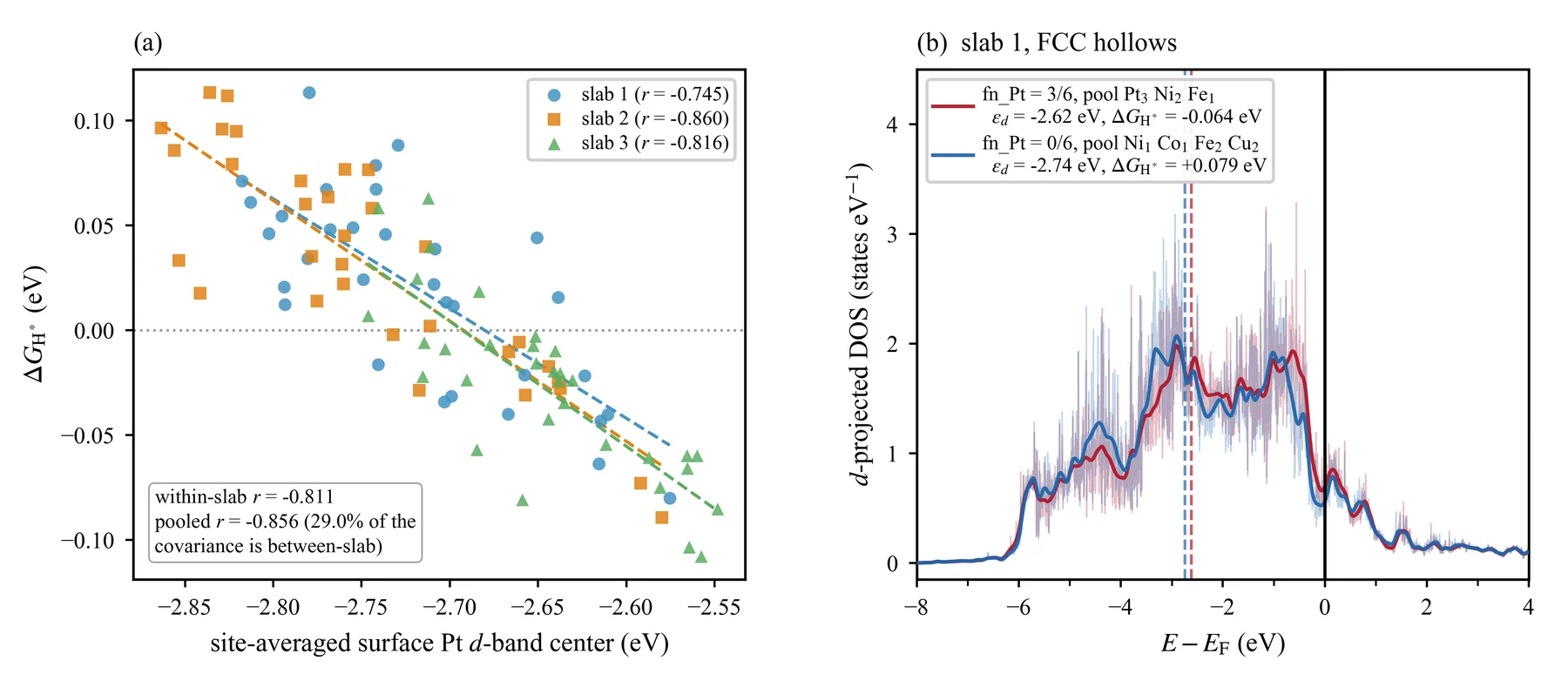
Figure 5 (manuscript). (a) ΔGH* vs the site-averaged surface-Pt d-band center, per slab. (b) d-projected DOS of a Pt-rich pool (εd = −2.62 eV) and a Pt-free pool (−2.74 eV).
−0.81 r
within-slab correlation (per slab −0.75, −0.86, −0.82); the pooled −0.86 includes 29% between-slab covariance
subsurface Pt ↑ → d-band center ↑ (closer to EF) → Pt–H stronger → ΔGH* more negative
The direction expected from the d-band model. The d-band spread within a slab (0.06–0.08 eV) is comparable to the spread of ΔGH*.
Key messageThe d-band center accompanies the composition trend within every slab — an association, not yet a mechanism.
12 / 18
Machine learning as a diagnostic, not a predictor
Random Forest and plain least squares on the same pool fractions — the honest test is leaving out a whole slab
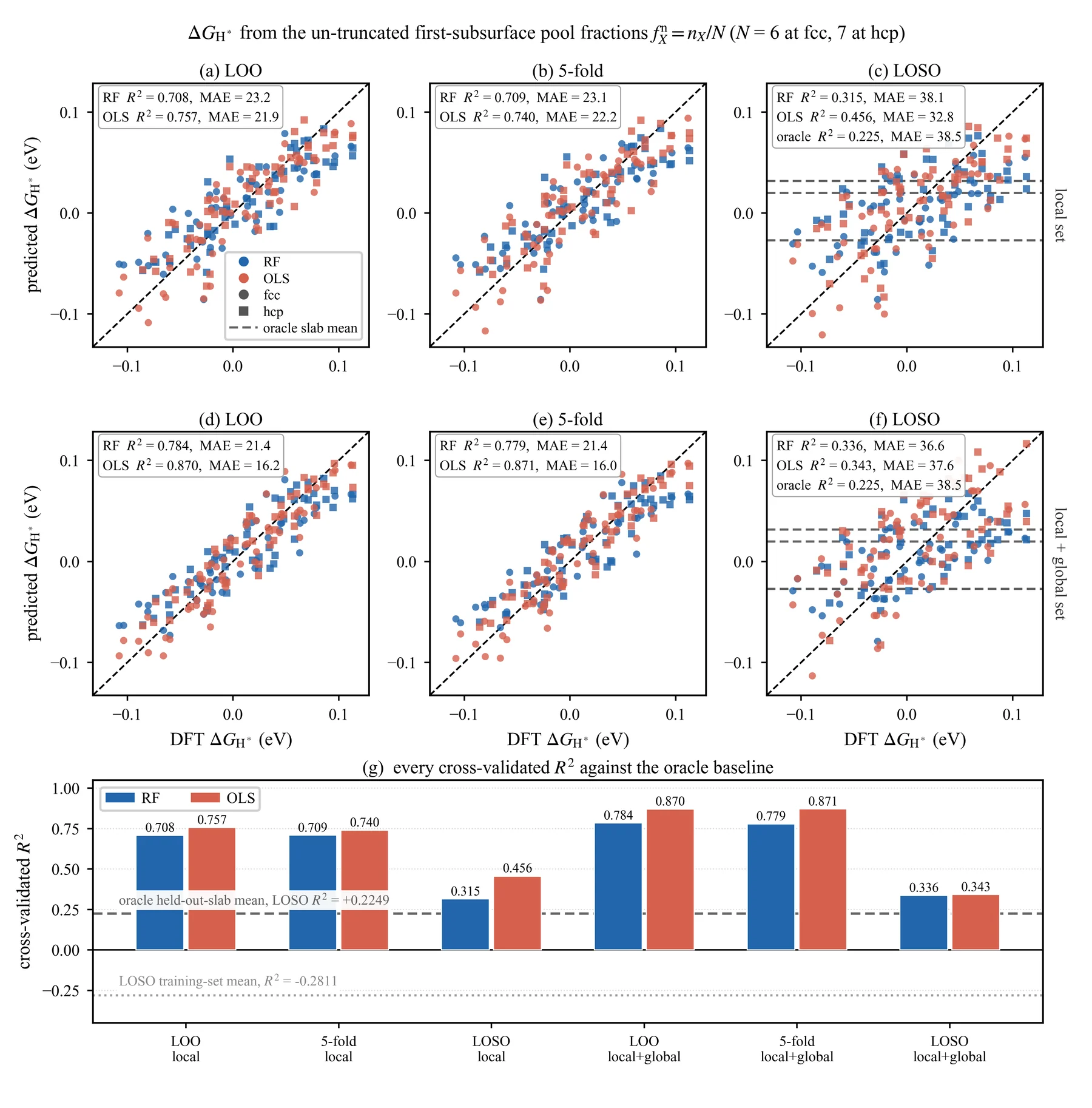
0.71 R² · MAE 23 meV
leave-one-site-out, local pool fractions — interpolation within a slab works
0.32 R² (RF) · 0.46 (OLS)
leave-one-slab-out — against an oracle that knows only the held-out slab's mean (R² = 0.23)
Plain least squares matches or beats the Random Forest on every protocol: the information is in the descriptor, not in model flexibility.
Scope Three slabs only; every model is negative on held-out slab 3. Consistent with the descriptor — not a transferable predictor.
Figure 6 (manuscript). Parity plots for leave-one-out, 5-fold and leave-one-slab-out; (g) every cross-validated R² against the oracle slab-mean baseline.
Key messageML defines the scope: pool fractions interpret ΔGH* within sampled slabs (≈ 23 meV) — not extrapolation.
Scope: what this work is, and what it is not
The conclusions apply to the studied model and to the adsorption descriptors examined
It is
Three SQS-derived Pt-skin (111) slabs of one nominal composition, at a common in-plane lattice constant
All 96 FCC + HCP hollow sites, one H per 4×4 cell, computational hydrogen electrode
A closure-aware decomposition of the site-to-site spread by the first-subsurface pool
It is not
Not a demonstration that a complete Pt skin forms on this alloy — the termination is an idealized model
Not a rate: no solvent, no electrode potential, no Volmer / Heyrovsky / Tafel barriers; no matched Pt(111) comparison
Not transferable yet: other compositions, lattice constants or partly mixed surfaces are untested; the d-band link is an association
Key messageWithin three slabs, the subsurface pool reads the spread of H binding; beyond them, we do not claim.
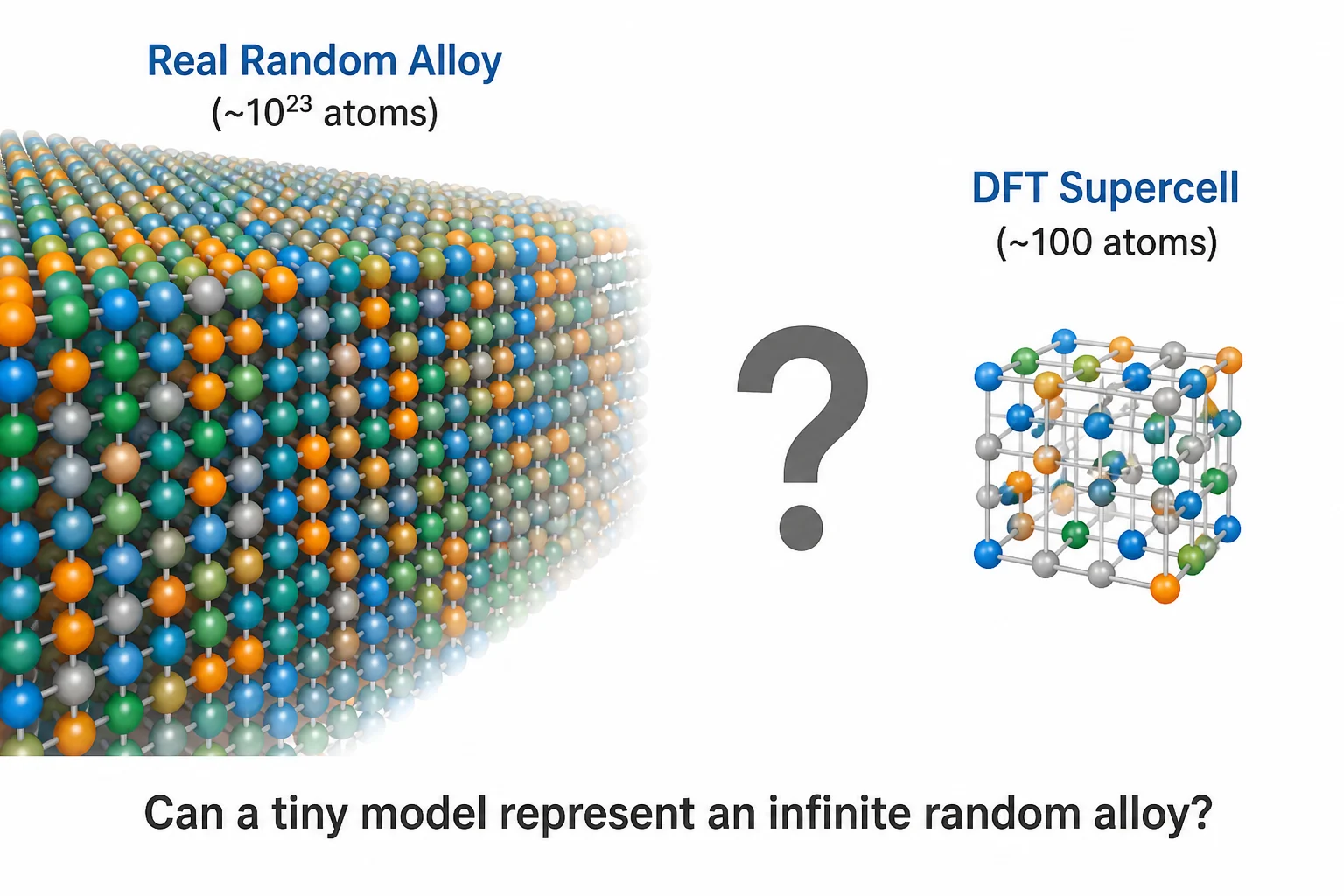
Can a small cell represent an infinite random alloy?
A real random alloy has ~1023 atoms; DFT can treat only ~100 — this is the gap an SQS bridges
A real random alloy is effectively infinite, but DFT can only treat ~100 atoms — the SQS is the small cell built to stand in for it.
Key messageAn SQS lets a ~100-atom DFT cell represent an effectively infinite random alloy.
Choosing an SQS: match the neighbours
Same composition, different arrangement — pick the one closest to random
clustered
mismatch: high
partly ordered
medium
random-like
low ✓ SQS
Count each atom's neighbours: the fractions should match the bulk composition.
Minimise the mismatch — the Warren–Cowley parameter α → 0 — over the nearest shells.
Next the following two slides show how that arrangement is actually found.
Key messageThe SQS is chosen by neighbour statistics, not by eye.
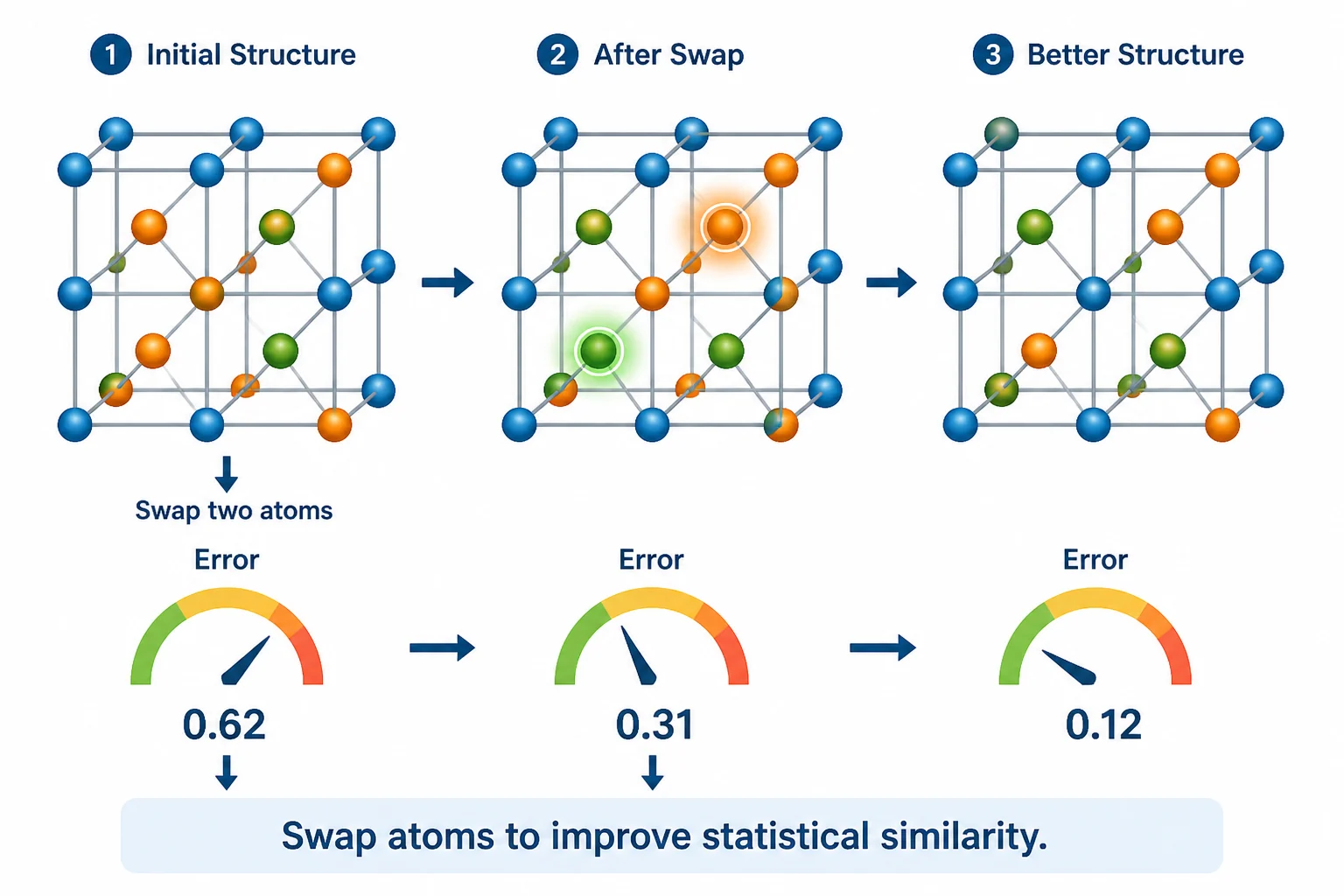
Finding an SQS is an optimization
Swap two atoms, re-score the neighbour statistics, keep what gets closer to random
Each swap proposes a candidate structure; the correlation mismatch (error) falls as the arrangement approaches a random alloy.
Key messageAn SQS is found by minimising the mismatch between its neighbour statistics and a true random alloy.
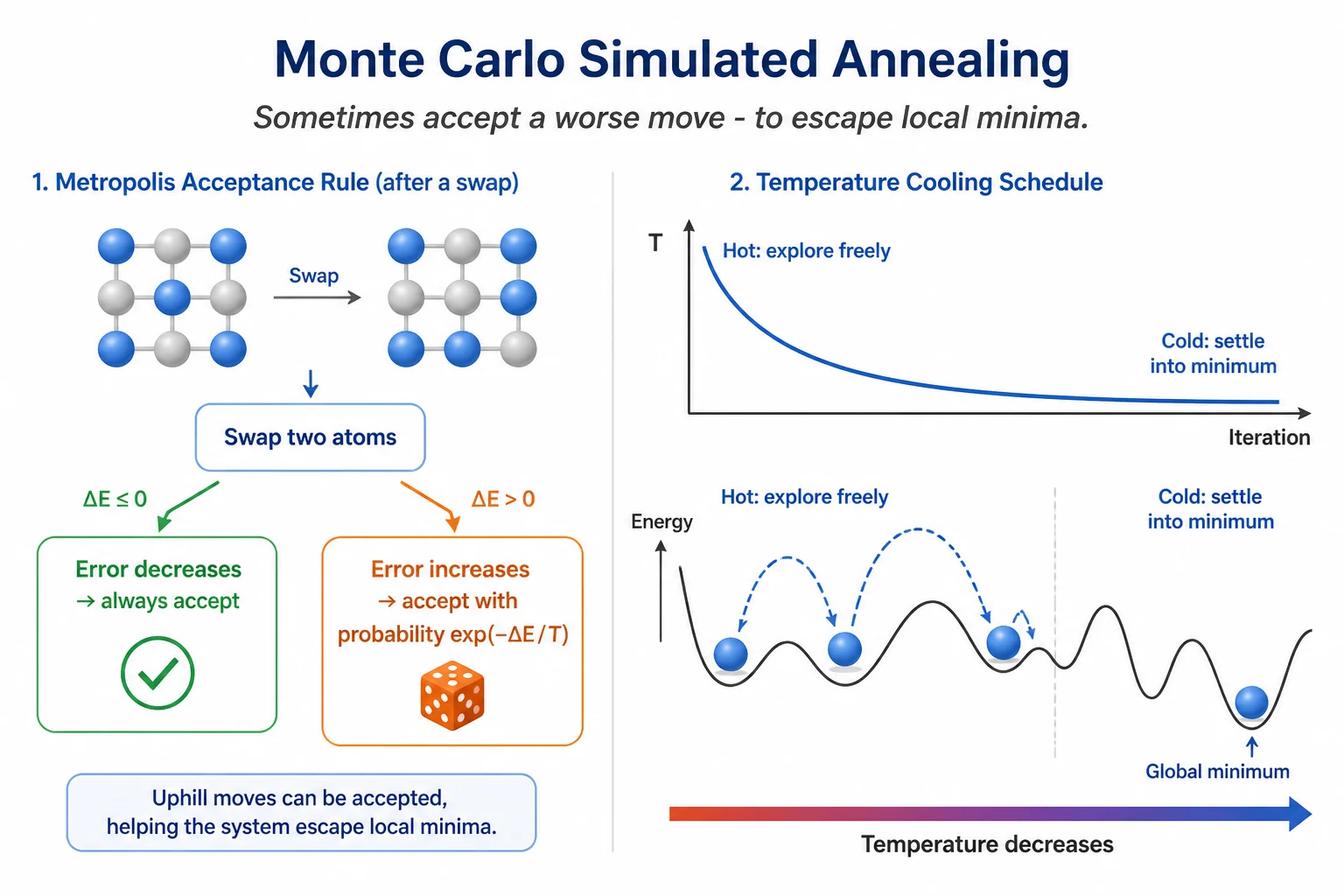
Monte Carlo annealing finds the global best
Always accept improving swaps; accept worsening ones with probability exp(−ΔE/T), cooling slowly
Simulated annealing accepts occasional uphill moves and lowers the "temperature" gradually, so the search escapes local minima and converges to the smallest statistical error.
Key messageAnnealing reaches the SQS with the lowest correlation mismatch — not just a nearby local minimum.
1 / 18
→ / Space reveal & next · ← back · O overview · F fullscreen · B blank · number+Enter jump